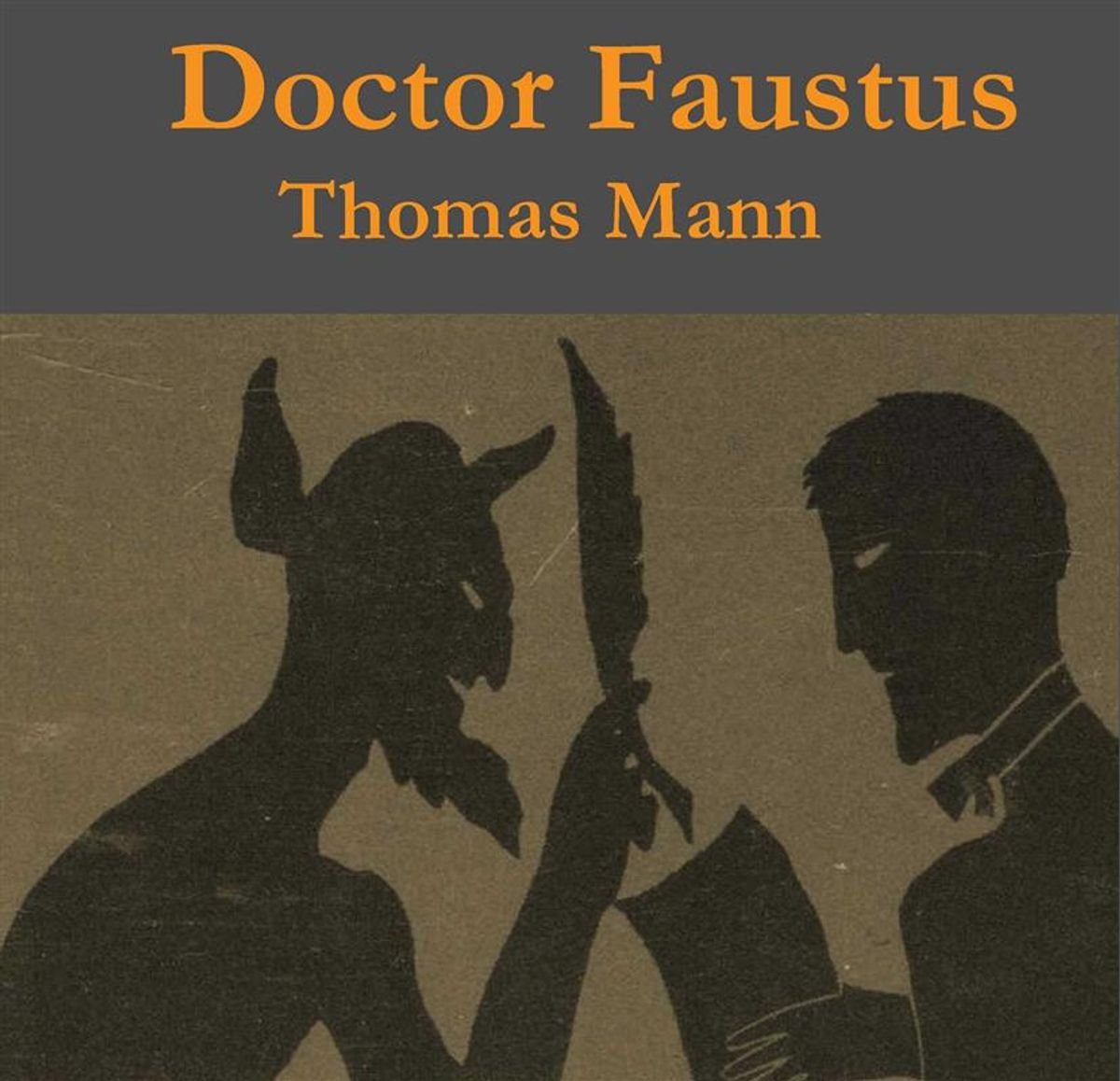
Thomas Mann: Doctor Faustus
Radio Romania Muzical
“Cuvantul Muzicii” programme
Transcript from Radio Romania Muzica “Cuvantul Muzicii” programme, with Ioan Tintea:
https://www.romania-muzical.ro/emisiune/cuvantul-muzicii/pianistul-cristian-sandrin/361781/7241
Cristian Sandrin, what is the title of the book you will be presenting to us today?
I will be presenting Thomas Mann's novel Doctor Faustus.
There is a lot to say about this novel. First of all, I would recommend the book to anyone who is passionate about classical music. Thomas Mann is an extraordinary writer. I find that chapter 8 contains one of the most beautiful texts ever written about Beethoven's music.
German writer Thomas Mann won the Nobel Prize for Literature in 1929, and Doctor Faustus is his last novel, written during his exile in Los Angeles, United States.
He lived through a very turbulent period in the history of Europe and Germany. He saw life under the German Empire, during the First World War, the Weimar Republic, then he saw the rise of Nazism, and when the Second World War broke out, he fled to the United States and then to Switzerland. All these upheavals had a profound influence on his thinking and his writing.
It is not a simple novel; even for me, who reads a lot, it was a challenge to read, but it was such an exercise in concentration. In an age when we are distracted by phone notifications, electronic devices, meetings, and social media, it was an exercise for me to sit down and devote myself to this extraordinary text.
It is a retelling of the legend of Faust. The most famous retelling of this medieval legend is by Goethe. Faust is a legend about this medieval scholar who dealt with forbidden knowledge, the occult. People said he made a pact with the devil. He sold his soul to gain magical powers, forbidden knowledge, riches, and worldly pleasures. In Goethe's version, Faust is an old scholar who makes a pact with the devil, Mephisto, to win the love of Gretchen. At the end of the version, Faust is saved, but Thomas Mann's novel is much darker.
Thomas Mann's Faust is imagined as a genius composer named Adrian. Adrian meets the devil and makes this pact, giving up his ability to love and be loved, his human candor, becoming a cold being, completely detached from the world around him. In exchange, he receives 24 years of creative genius from the devil. From that moment on, the music of this composer, Adrian, becomes increasingly radical and influential. It begins to be played all over the world. The press and critics praise him as a genius composer who breaks down traditional values. The entire history of music is changed because of this composer, Adrian. Unfortunately, as we know, after 24 years, this creative genius is about to fade away, and Adrian falls into madness and dies.
As I said earlier, I was very moved by this novel, knowing full well that Thomas Mann conceived the entire novel as an allegory of his country, Germany. How culture descended into chaos through Nazism and World War II.
Why should we read and how does reading help us in our daily lives?
It is very important to read nowadays. As I said earlier, for me it is an exercise in concentration, I escape from daily disturbances. We know from scientists and neurologists that when we read stories, we somehow activate brain networks that we use in real life when we try to understand real people, emotions, intentions, and somehow relive other lives.
We become wiser, more empathetic. And that is very important nowadays.